Reed Music Publishing
Exploring Options Related to Music Education

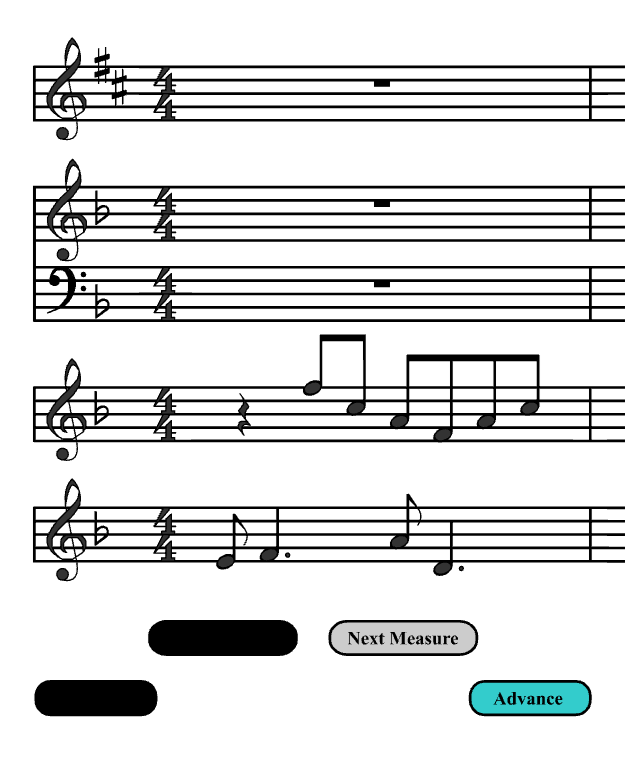
Flash Music Display I found a number of drawbacks when using my new Flash library to
re-create one of my compositions. First of all,
the grand staff (treble & bass) should be taller. Normally, there
are two locations for display of Middle C, not just one; there is not enough
space between the middle of the staves.
Sec- ond, editing was sometimes cumbersome -- as notation heads often had to be swapped prior to placement. Furthermore, notes
were placed at precise intervals on the x and y axis (y: 5px up/down changed the pitch). It is a good first start, but
somewhat tedious.

Applicable Use With further refinements,
use of Flash to display music could work for illustrative purposes, but syncing audio to dis-
played content may prove too difficult. It should be noted that all the notes
are upright. Any revisements should correct this as there is only so much room above and below each staff. With regard to
audio, sometimes it can be com- pressed too much (there can often be a loss in fidelity). The composition at the right
was written prior to 2004, but was never finished -- and as heard
here, is one of several
compositions that I have written. The score is in the Key of F.
At times, the quality of some SoundFonts can be low. As was the case in the NHL Theme Song Competition, the trumpet SoundFont I used was weak at the high end of its range. This will generally be the case with SoundFonts, and even in real settings, trumpet players tend to avoid the high and low ends of their instrument's pitch range. Generally, a composer will not write parts that reach either end of this range -- and instead use notes that are more "comfortably" played. Generally, those with lots of experience can reach the highest notes.
A lot of computer-based work can go into a piece of music, but it isn't always possible to produce something of equal quality to real instruments/players. Though the sound generated from computers has improved over the years, it can still be somewhat arti- ficial at times. As heard at Sounds Online, sometimes the right orchestration can make all the difference. All of the sounds are sampled from real instruments, as was the case with the Fab-Four instrument.
The Road Ahead
For several years, I have used Vienna SoundFont Studio to organize sounds that I have recorded from sequencers and other audio sources (including those of EastWest). One inevitably ends up adjusting audio in the left and right channel, whether it is MIDI or not. The right mix can take a while to achieve, and sometimes not be reached at all. With respect to printed music and use of Flash, it can also be tailored visually. As is the case with audio, large amounts of memory & processing power can be necessary at times. Audio is not just 32 bit now; it is also 64 bit as well. Quality can sometimes depend on the sample itself.
For this assignment, I set out to create Flash music notation that is scrollable -- and have avoided use of any audio or syncing. The next step would be to generate both the visual display and sound output with Flash, but that will require a little more thought and consideration. Generating music via software is not a task that is always easy, but in the long run, many things can be achieved through use of computers -- and sampled audio. Artificial instruments sometimes don't sound artificial. Even Flash has improved.
Copyright @copy 2013 Alan Colquhoun HomeCompositionEducationContact Me
